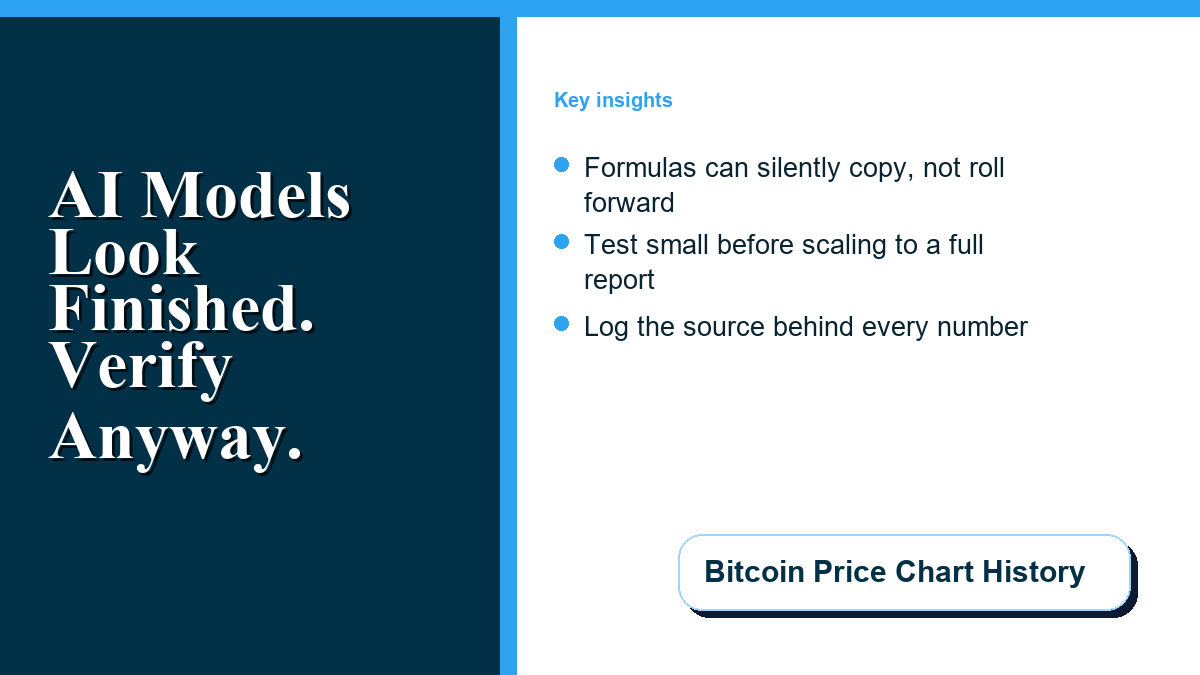
AI-generated financial models look finished before they’re actually true — polished formatting, clean formulas, a professional-looking output that can hide a broken assumption or a cell reference pointing at the wrong row. The capability jump in early 2026 made these tools genuinely useful for serious modeling work for the first time; it did not make them trustworthy without verification.
The Specific Ways These Models Fail
The most common failure isn’t an obviously wrong number — it’s a formula that copies the same two cells across every future projection year instead of rolling forward correctly, or a model saved as a spreadsheet with almost no live formulas actually inside it, just hardcoded values dressed up to look calculated. Both failures pass a casual glance. Neither survives someone actually clicking into the cells.
Building a Verification Layer Before Trust
Before an AI-generated model enters a real review cycle, it needs a documented validation protocol: who checks the balance sheet balances, who runs a formula-consistency check across every projection period, and who validates the output against historical actuals. Treating this as a formality rather than a real gate is how a plausible-looking error makes it into a decision.
The Three Questions Worth Asking About Any AI-Generated Number
- Where did the underlying data actually originate? A number is only as trustworthy as its source, and AI output makes that source less visible than a manually built model where the analyst remembers where each figure came from.
- Was any consolidation logic applied, and is it correct? Combining data across periods, entities, or currencies is exactly where subtle errors hide.
- Was the query that generated this output logged in an auditable trail? If nobody can reconstruct how a number was produced, nobody can verify it after the fact either.
A Practical Test Before Scaling Up
Validate on a small sample before trusting the output at full scale — run the model against known historical data first, isolate any discrepancy while it’s still small and traceable, and only then extend the same approach to a full report or forward projection. A model that passes a small, checkable test is a meaningfully different proposition than one that’s never been tested against anything verifiable.
Tools built around traceable, reviewable outputs — where the underlying reasoning and sources stay attached to the result rather than disappearing into a black box — make this verification step genuinely practical instead of a theoretical best practice nobody has time for. Charigent’s Artifacts feature is built around keeping that kind of traceable output attached to its source material.
The Bottom Line
AI has made building a first-draft financial model dramatically faster. It has not changed the fact that someone still has to verify the model is actually right before anyone makes a decision based on it — that responsibility didn’t transfer to the AI along with the drafting work.



0 Comments