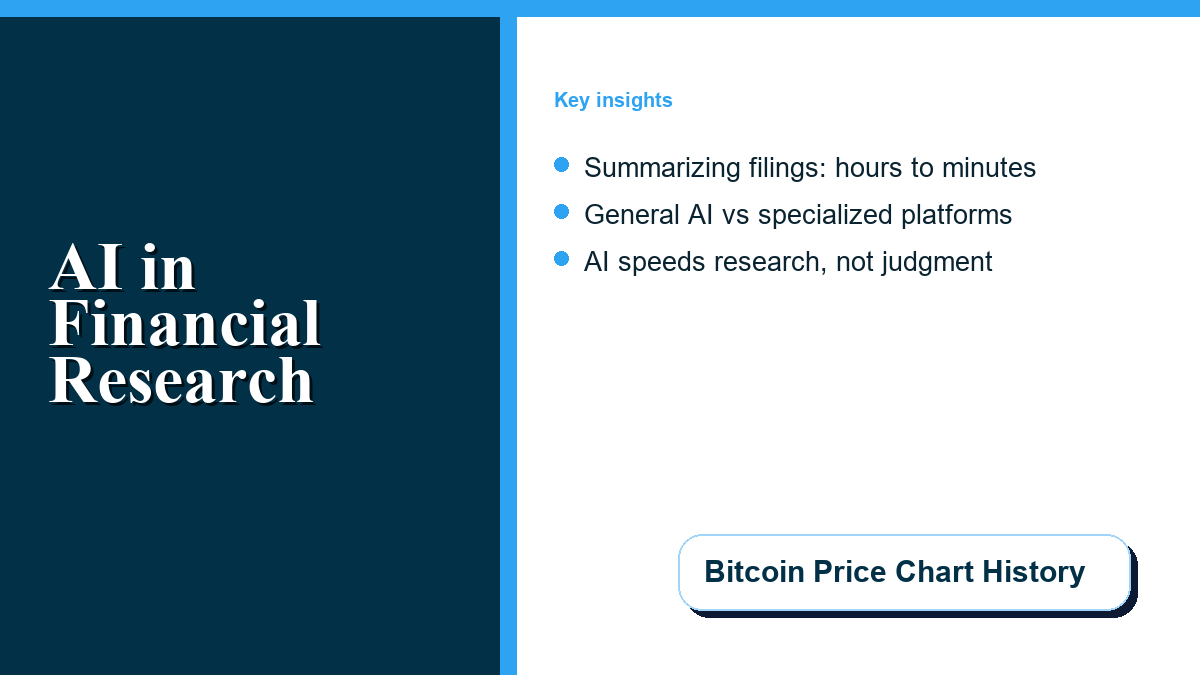
Financial research used to mean hours reading filings, earnings transcripts, and market reports before forming a single conclusion. AI tools built for this specific job have compressed that timeline dramatically — the question worth asking isn’t whether they help, it’s exactly where they help and where a human still has to do the real thinking.
Where AI Genuinely Speeds Things Up
Summarizing unstructured data is the clearest win: pulling the relevant numbers and claims out of a dense filing or earnings call transcript and surfacing them in minutes instead of hours. Document review and first-draft preparation — pitch books, due diligence summaries, research memos — follow the same pattern. The AI handles the compression of large amounts of text into a structured starting point; a human still decides what the structure should conclude.
Specialized Tools vs. General-Purpose AI
General-purpose AI assistants now handle a meaningful share of everyday financial analysis work — summarizing a document, drafting a first pass at a memo, checking arithmetic on a model. Specialized financial research platforms go further: automated investment memos, structured due diligence documents, and multi-agent research systems built specifically around financial data formats. The tradeoff is straightforward — general tools are flexible and cheap to start with, specialized platforms are built for a narrower job and do it with fewer manual corrections needed afterward.
What AI Still Doesn’t Do
None of these tools replace judgment about what a number actually means in context, or why a company’s story doesn’t add up despite technically accurate individual claims. AI accelerates the research step; it does not replace the analytical step where someone decides whether an investment thesis actually holds up. Treating a well-organized AI summary as a finished conclusion, rather than a faster starting point, is the most common way this goes wrong.
A Practical Way to Evaluate a Tool
- Does it cite its sources specifically, or summarize without attribution? A financial summary you can’t trace back to the original filing isn’t verifiable when it matters.
- Does it handle your actual document types? A tool tuned for public equity filings may handle a private company’s data room poorly.
- How much editing does the output actually need? The real time savings show up only if the first draft needs light editing, not a rewrite.
Platforms built around structured content and research workflows — where a brief, a draft, and supporting analysis stay connected rather than living in separate documents — make this kind of work easier to manage end to end. Charigent’s analytics feature set is one example built around keeping research and reporting connected in one workspace.
The Bottom Line
AI has genuinely changed how fast financial research moves — it has not changed who’s responsible for the conclusion at the end of it.



0 Comments